

Consequence-based risk modelling uses likelihood for less-consequential attacks and ignores likelihood for attacks where misinterpretation can have very serious consequences. At its most conservative, consequence-based modelling includes the following.
- To encompass even deterministic attacks, likelihood is set to 1 when potential impacts are unacceptable.
- When cyber risk cannot be effectively eliminated by procedural, electro-mechanical and other “deterministic” measures, the system in question must be protected by the strongest practicable cyber measures. In the IEC 62443 standard, SL4 are the strongest protections.
Note: Engineering mitigations in this example are mitigations used by safety engineering and the Cyber-Informed Engineering methodology. Examples include manual operations fall-backs and overpressure-relief valves. Such mitigations are independent of cyber compromise and thus can be regarded as deterministic, remaining effective when cyber-based protection mechanisms have been compromised.
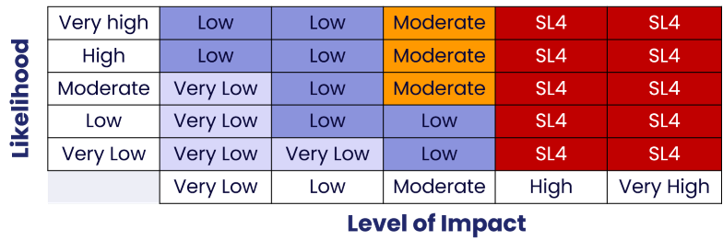
Figure (1) illustrates such a risk matrix. In the matrix, acceptable consequences, or worst-case consequences that have been rendered acceptable by the introduction of non-cyber mitigations, reflect likelihood in their risk assignments. Unacceptable consequences ignore likelihood. In this example, both likelihood and impact contribute to low and medium security level outcomes, and likelihood has no impact on the SL4 target assigned to high and very high impact outcomes the organization in this example has deemed unacceptable.
Note: When using this kind of matrix, assessors estimate very cautiously the activation frequency (AF) for engineering mitigations that can be triggered by a worst-case cyber attack. For example, given that the historical Triton attack caused Safety-Instrumented Systems to shut down a petrochemical facility twice before being detected and eradicated, it may be reasonable to set the AF for unhackable safety systems at 2-5 activations per year.
A more sophisticated consequence-based approach addresses two limitations of the “Likelihood = 1” approach:
- The approach’s very cautious assumptions can be “overkill” and result in deploying expensive mitigations that are materially in excess of what is justified by the cyber threat.
- SL4 may not be sufficient to mitigate some high-consequence scenarios. For example, some kinds of damage to electric power equipment might be deemed unacceptable in critical infrastructure applications, but most industrial systems deploy software protective relays rather than more deterministic electro-mechanical protections to protect electrical equipment from damage.
The concept of “credibility” is used to address these limitations. Credibility is defined as what is reasonable to believe, for example about:
- adversary intent and capabilities,
- attack opportunities that may remain in defensive postures, and
- what consequences are reasonable to expect when credible attacks meet cyber defenses.
An example of a corresponding risk matrix is illustrated in Figure (2).
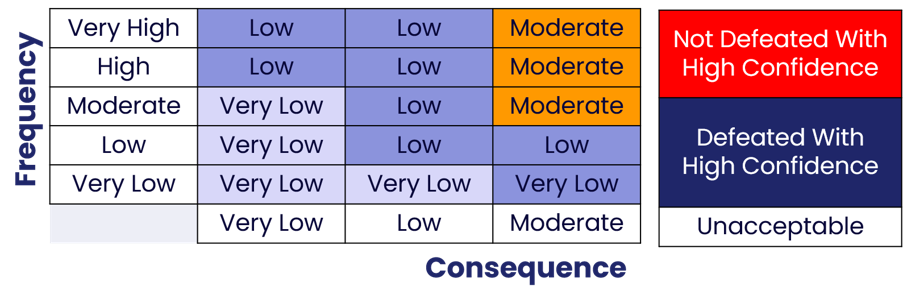
In this matrix, again, likelihood is used conventionally for scenarios where impacts are deemed acceptable losses. For unacceptable consequences, the theoretical set of possible attack scenarios, including “science fiction” scenarios that are not considered credible, is divided into two subsets. The lower set in the diagram is the set of attacks that the defensive posture under consideration defeats with a high degree of confidence. The upper set is not thus defeated. All attacks in the set, if successful, have unacceptable consequences.
In this formulation, risk assessors evaluate what attack capabilities of known and postulated adversaries are reasonable to expect – ie: which attacks are credible. For credible attacks, assessors evaluate the effectiveness of SL1-4 mitigations against those attacks, and generally assign a security level greater than or equal to the lowest level expected to defeat the attack scenario with a high degree of confidence, or reduce consequences to an acceptable level. For example, most practitioners would determine that an MFA token defeats password phishing attacks with a high degree of confidence, but may not defeat a phishing attack joined with a zero-day exploit of the MFA system.
This analysis may result in credible threats and attacks with unacceptable consequences that are not defeated by a high degree of confidence, even after deploying SL4 protections. When this is the case, the risk assessment is required to document these residual risks and communicate these risks to authorities in the owner and operator who are responsible for managing risk.
Caution: When evaluating credible consequences of a specific attack scenario, we must account for cyber common cause failures. Any attack that can compromise both the primary and secondary security controls counts as such a failure. For example, multiply redundant protective relays of the same make and model may be strong protection against random relay equipment failures. However, if those same relays are all deployed in the same network zone, they risk being compromised simultaneously by a network-based exploit of a remote code execution vulnerability in the relay software.
